

All You Need to Know About Disorganized Attachment
Relationships are at the core of our emotional lives. But for some, closeness feels both comforting and threatening at the same time. This often traces back to a pattern called disorganized attachment. If you’ve ever wondered why your relationships feel confusing or why you push people away while craving closeness, this guide explains everything you need to know.
What Is Disorganized Attachment?
Disorganized attachment (also known as fearful-avoidant attachment) is one of the four main attachment styles identified in psychology. It develops in childhood when a caregiver — usually a parent — is both a source of comfort and fear.
Because the child doesn’t know whether they’ll receive warmth or rejection, they experience an internal conflict: wanting closeness but fearing it at the same time. This confusion can later show up in adult relationships as mixed signals, anxiety, or avoidance.
Signs of Disorganized Attachment
Adults with a disorganized attachment style may show a blend of anxious and avoidant behaviors. Common signs include:
- Craving closeness but feeling unsafe when it happens
- Difficulty trusting others or feeling secure in relationships
- Sending mixed signals (pulling people close, then pushing them away)
- Strong emotional reactions or sudden mood shifts
- Feeling unworthy, afraid of rejection, or worried about abandonment
- You don’t have to tick every box to have this style, but noticing these patterns can be the first step toward change.
Causes of Disorganized Attachment
Disorganized attachment usually begins in childhood. Common causes include:
- Trauma or neglect: Physical, emotional, or sexual abuse can create fear around closeness.
- Inconsistent caregiving: A caregiver who is warm sometimes and frightening or absent at other times.
- Parental mental illness or addiction: Unpredictable behavior can confuse a child’s sense of safety.
- Loss or repeated separations: Long hospital stays, divorce, or death of a parent.
- These early experiences shape a child’s nervous system and belief about relationships — but they don’t have to define you forever.
How It Affects Adult Life
Disorganized attachment can make adult relationships feel like an emotional rollercoaster. It may lead to:
- Fear of intimacy alongside fear of being alone
- High conflict or push-pull dynamics in partnerships
- Difficulty trusting partners, friends, or coworkers
- Problems with self-esteem and emotional regulation
- Understanding these patterns is empowering. When you see the roots, you can start to change them.
Healing from Disorganized Attachment
Attachment styles are not permanent. With time and the right support, you can move toward secure attachment, where closeness feels safe and balanced. Some ways to heal include:
- Therapy – Especially trauma-informed approaches (like EMDR, somatic experiencing, or attachment-focused therapy).
- Self-awareness – Journaling, mindfulness, and reflection help you notice your triggers and patterns.
- Healthy boundaries – Learning when and how to say “yes” or “no” builds trust in yourself.
- Safe relationships – Surrounding yourself with consistent, supportive people helps rewire old patterns.
- Self-compassion – Treating yourself kindly reduces shame and fear.
Moving Toward Secure Attachment
Change doesn’t happen overnight, but every small step matters. Building secure attachment means:
- Feeling comfortable with closeness and independence
- Trusting others more easily
- Regulating emotions without panic or shutdown
- Forming relationships that feel stable and supportive
It’s possible to re-learn safety and connection at any age.
How Attachment Forms in Early Childhood
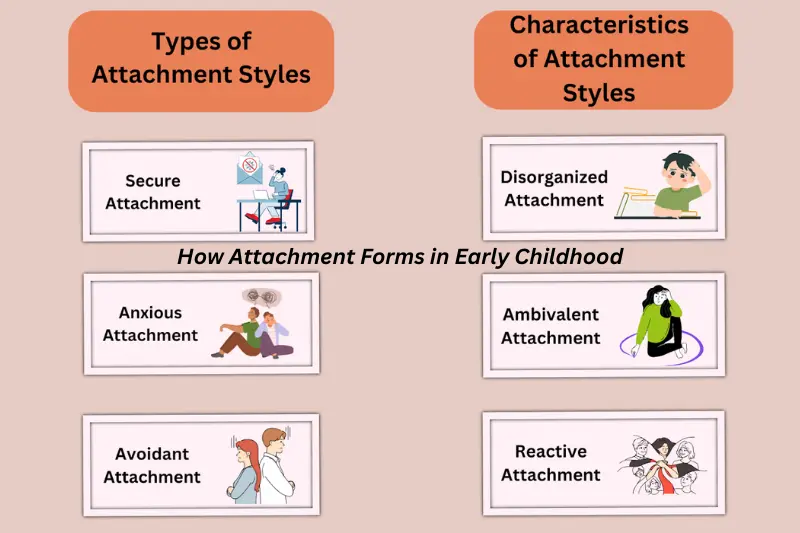
Attachment is the deep emotional bond that develops between a child and their primary caregiver. It lays the groundwork for how we relate to others for the rest of our lives. Understanding how it forms helps explain why secure, consistent care in early years matters so much.
The Basics of Attachment
From birth, babies are biologically wired to seek closeness and safety. Crying, smiling, and clinging are not just behaviors — they’re survival strategies designed to keep the caregiver nearby. When the caregiver responds consistently, the child learns: “The world is safe. My needs will be met.”
Key Stages of Attachment Formation
- Birth to 2 months: Babies recognize voices and smells but don’t yet prefer one caregiver.
- 2 to 6 months: Infants begin to show preference for familiar people and respond with smiles or coos.
- 6 to 12 months: “True” attachment emerges. Babies show separation anxiety, stranger wariness, and actively seek comfort from their main caregiver.
- 12 months and beyond: Toddlers use the caregiver as a “secure base,” exploring the world but returning for reassurance.
What Shapes Attachment Quality
The consistency, sensitivity, and warmth of the caregiver’s responses matter most. When caregivers:
- Respond promptly to distress
- Offer comfort and emotional attunement
- Provide safe, predictable routines
If caregiving is inconsistent, neglectful, or frightening, the child may develop an insecure attachment style (anxious, avoidant, or disorganized).
Why Early Attachment Matters
Early attachment experiences shape:
- How children regulate emotions
- How safe they feel exploring the world
- Their capacity to trust and form relationships later in life
While early patterns are powerful, they’re not destiny. With supportive relationships and, if needed, therapy, people can shift toward healthier attachment styles even in adulthood.
How the Disorganized (Fearful-Avoidant) Attachment Style Develops
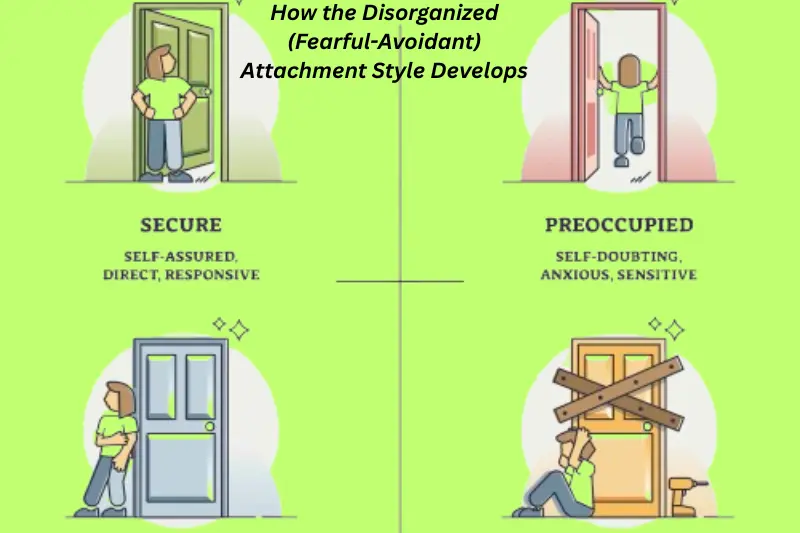
The disorganized attachment style — also called the fearful-avoidant attachment style — emerges when a child’s main source of comfort is also a source of fear. This confusing dynamic creates an inner conflict that can shape relationships well into adulthood.
Early Roots: The Caregiver as “Safe” and “Scary”
From birth, babies are wired to seek safety and closeness with their caregivers. If a caregiver is warm, predictable, and responsive, the child develops a secure attachment — they trust that their needs will be met.
But if a caregiver is unpredictable, frightening, or emotionally unavailable, the child’s nervous system receives mixed signals:
- Approach: “I need you to feel safe.”
- Avoid: “I’m scared of you; closeness feels dangerous.”
This push-pull becomes the foundation of disorganized (fearful-avoidant) attachment.
Common Childhood Experiences That Contribute
Research shows disorganized attachment often develops when children experience one or more of the following:
- Abuse or neglect (physical, emotional, or sexual)
- Inconsistent caregiving — warmth at times, rejection or fear at others
- Parental trauma, addiction, or mental illness creating unpredictable behavior
- Repeated separations or loss of a primary caregiver
- Witnessing domestic violence or frightening conflict
These experiences can overwhelm a child’s developing stress system. Without a consistently safe adult to regulate their emotions, the child struggles to learn healthy ways of soothing themselves.
What the Child Learns Internally
Because of these mixed signals, children with disorganized attachment often internalize messages like:
- “I can’t trust others to protect me.”
- “I have to be on alert.”
- “Love and danger go together.”
This internal blueprint shows up later as conflicting adult behaviors: craving closeness but fearing intimacy, pushing people away while longing for connection, or intense mistrust mixed with emotional dependence.
A Key Point: It’s Not Permanent
While disorganized or fearful-avoidant attachment begins in childhood, it’s not a life sentence. With therapy, supportive relationships, and self-awareness, many people gradually move toward secure attachment, where closeness feels both safe and rewarding.
What Causes Disorganized Attachment in Children?
Disorganized attachment develops when a child’s main caregiver is both a source of comfort and a source of fear or unpredictability. The child wants closeness but also feels unsafe approaching the caregiver, which creates confusion and distress.
Common Contributing Factors
- Abuse or neglect – Physical, emotional, or sexual abuse can make the caregiver frightening.
- Inconsistent caregiving – Warm and responsive at times, rejecting or absent at others.
- Exposure to domestic violence – Even if the child isn’t harmed directly, seeing frightening conflict can be traumatic.
- Parental mental illness or addiction – Unpredictable moods or behaviors can disrupt a child’s sense of safety.
- Loss or repeated separations – Death, divorce, foster care, or long hospital stays without consistent caregiving.
- Unresolved trauma in the caregiver – A parent who hasn’t healed their own trauma may unintentionally act in ways that scare or confuse the child.
The Core Issue
It’s not one single event but a pattern of mixed signals: the caregiver is the person the child turns to for help but is also experienced as dangerous, unavailable, or inconsistent. Over time, the child develops disorganized attachment strategies to cope.
Key Point
Although early experiences strongly shape attachment, these patterns are not permanent. Consistent, nurturing care, therapy, and supportive relationships can help children (and later adults) develop more secure attachment over time.
What Relationships with Fearful-Avoidant (Disorganized) Adults Look Like
Adults with a fearful-avoidant attachment style—also called disorganized attachment—carry a deep inner conflict: they crave closeness and connection but also fear being hurt or rejected. This push-pull shows up very clearly in their relationships.
Common Patterns You Might See
- Mixed signals: They may be affectionate and intensely interested one day, then distant or withdrawn the next.
- Fear of intimacy: They want deep emotional connection but feel overwhelmed when it gets too close.
- Difficulty trusting: Even with a loving partner, they may suspect betrayal or abandonment.
- Heightened reactivity: Small disagreements can feel like huge threats, leading to sudden mood changes or conflict.
- Self-sabotage: They may end relationships prematurely or test a partner’s love to confirm their fears.
- Over-independence followed by clinging: They oscillate between needing space and needing reassurance.
How It Feels for Their Partners
Partners often describe the relationship as a “rollercoaster” of closeness and distance. They may feel confused by the mixed signals or unsure how to meet the fearful-avoidant adult’s needs.
Why This Happens
Fearful-avoidant adults learned early on that love and fear go hand in hand. In adulthood, their nervous system still associates intimacy with danger, so they instinctively push away just as they want to get close.
Hope for Change
These patterns are not fixed. With self-awareness, therapy, and supportive partners, fearful-avoidant adults can gradually develop more secure ways of relating—where trust, openness, and healthy boundaries replace the old cycle of closeness and fear.
Can you change a disorganized attachment style?
Absolutely — a disorganized attachment style is not permanent. Because attachment patterns are learned responses to early experiences, they can be reshaped with new experiences, self-awareness, and support. It takes time, but many people move from fearful-avoidant (disorganized) toward a more secure style.
Why Change Is Possible
Attachment styles are built on what your nervous system learned about safety and closeness in childhood. Your brain and body remain plastic throughout life — meaning new, consistent, and healthy relational experiences can “retrain” your system.
Practical Ways to Shift Toward Secure Attachment
Therapy
- Look for trauma-informed or attachment-focused approaches (like EMDR, somatic experiencing, Internal Family Systems, or emotionally focused therapy).
- Therapy provides a safe, consistent relationship that helps your nervous system practice trust and co-regulation.
Build Self-Awareness
- Journal your emotional triggers and relationship patterns.
- Learn to notice when you’re pulling away or clinging so you can pause and choose a new response.
Practice Emotional Regulation
- Mindfulness, breathwork, or grounding exercises teach your body to calm down when intimacy feels threatening.
Seek Safe, Consistent Relationships
- Spend time with people who are reliable and respectful of your boundaries.
- Over time, your system starts to expect consistency and safety.
Develop Healthy Boundaries
- Clear “yes” and “no” build self-trust and reduce the push-pull dynamic common in disorganized attachment.
Self-Compassion
- Remind yourself your patterns are adaptations, not flaws.
- Treat setbacks as learning moments rather than proof you’re “broken.”
What to Expect
Change usually feels gradual: fewer emotional spikes, more ability to tolerate closeness, and better communication about your needs. Most people see progress in months or years rather than weeks — but even small shifts can transform relationships.
How to Heal a Disorganized Attachment Style in Adults
A disorganized (fearful-avoidant) attachment style develops when a person’s early experiences of love were mixed with fear or unpredictability. As adults, this can lead to craving closeness but fearing it at the same time. The good news: attachment styles aren’t fixed. With intentional effort, adults can move toward a more secure, stable way of relating.
Understand Your Patterns
- Awareness is the first step to change.
- Take an attachment style quiz or read about common patterns.
- Journal moments when you feel triggered, pull away, or cling.
- Notice how your body reacts in stressful relational moments (tight chest, racing heart, shutting down).
Naming your reactions helps you pause and choose different responses instead of acting automatically.
Seek Trauma-Informed Therapy
Because disorganized attachment often stems from early trauma, therapy that addresses both your thoughts and nervous system can be especially helpful:
- EMDR (Eye Movement Desensitization and Reprocessing)
- Somatic Experiencing
- Internal Family Systems (IFS)
- Emotionally Focused Therapy (EFT) for couples
A therapist becomes a safe, consistent presence where you can practice trust and emotional regulation.
Practice Self-Regulation
Learning to calm your body when you feel threatened by closeness can reduce the “fight, flight, freeze” response.
- Deep breathing or grounding exercises
- Mindfulness or meditation apps
- Gentle movement (yoga, walking)
- Naming your feelings out loud (“I feel scared” or “I feel tense”)
These techniques teach your nervous system that intimacy isn’t automatically dangerous.
Build Healthy Boundaries
- Boundaries protect both you and your relationships.
- Be clear about your limits and needs.
- Say “no” without guilt and “yes” intentionally.
- Practice communicating needs in small, low-stakes situations first.
- Boundaries create safety, which helps your system relax into connection.
Choose Safe, Consistent Relationships
- Surround yourself with people who are reliable, respectful, and emotionally available.
- Notice how your body feels around them — do you feel calmer or on edge?
- Gradually allow closeness at a pace that feels manageable.
- Celebrate small successes (staying open during conflict, asking for support).
- Over time, repeated experiences of safety rewire your attachment patterns.
Practice Self-Compassion
- Healing isn’t linear. You may slip back into old behaviors during stress.
- Remind yourself these patterns are adaptations, not flaws.
- Speak to yourself as you would to a friend.
- Track progress, not perfection.
- Self-compassion helps reduce shame — which is often at the heart of disorganized attachment.
What to Expect
Shifting your attachment style is usually gradual. Signs of progress include:
- Feeling calmer in close relationships
- Less fear of abandonment or rejection
- More consistent communication and trust
- Greater ability to set and respect boundaries
FAQs on Disorganized Attachment Style
What is disorganized attachment style?
Disorganized attachment style (also called fearful-avoidant) is an insecure attachment pattern where a person both craves closeness and fears it. It often develops in childhood when a caregiver is a source of both comfort and fear.
What causes disorganized attachment?
It usually stems from early experiences such as inconsistent caregiving, trauma, neglect, loss of a parent, or exposure to frightening or unpredictable behavior. These mixed signals confuse a child’s sense of safety and can lead to disorganized attachment in adulthood.
How does disorganized attachment show up in adults?
Adults may send mixed signals — seeking intimacy while also pulling away, having a hard time trusting partners, or feeling overwhelmed by closeness. Relationships often feel like an emotional “push-pull” cycle.
Is disorganized attachment the same as fearful-avoidant attachment?
Yes. In adult attachment research, “fearful-avoidant” is the term often used to describe the same pattern identified as “disorganized” in children.
Can disorganized attachment style be changed?
Yes. Attachment styles are learned and can shift with new experiences. Therapy (especially trauma-informed), building self-awareness, practicing emotional regulation, and developing supportive, consistent relationships can all help a person move toward a more secure attachment style.
How can someone with disorganized attachment heal?
Start by learning about your patterns, practicing self-compassion, setting healthy boundaries, and seeking therapy or coaching with someone trained in attachment work. Over time, repeated safe and supportive experiences help “rewire” your nervous system.
What does a relationship with a fearful-avoidant person look like?
It can feel like a rollercoaster — periods of intense closeness followed by sudden distance. The person may fear abandonment but also fear intimacy, creating push-pull dynamics. Understanding the pattern can help both partners respond with more empathy.
Can a securely attached partner help?
Yes. Being with a reliable, emotionally available partner can be very healing. However, it’s not their job to “fix” the attachment style; self-work and, if possible, therapy are important, too.
Sources
Here are some reputable, evidence-based sources you can cite for your content on disorganized (fearful-avoidant) attachment style:
Academic & Research Sources
- Ainsworth, M. D. S., Blehar, M. C., Waters, E., & Wall, S. (1978). Patterns of Attachment: A Psychological Study of the Strange Situation. Hillsdale, NJ: Erlbaum.
- Main, M., & Solomon, J. (1990). Procedures for identifying infants as disorganized/disoriented during the Ainsworth Strange Situation. In M.T. Greenberg, D. Cicchetti, & E.M. Cummings (Eds.), Attachment in the Preschool Years: Theory, Research, and Intervention (pp. 121-160). University of Chicago Press.
- Lyons-Ruth, K., & Jacobvitz, D. (2016). Attachment disorganization from infancy to adulthood: Neurobiological correlates, parenting contexts, and pathways to disorder. In J. Cassidy & P.R. Shaver (Eds.), Handbook of Attachment (3rd ed., pp. 667-695). Guilford Press.
Professional & Clinical Resources
- American Psychological Association (APA):
Attachment and Relationships - Attachment Theory in Adults – University of California, Berkeley Greater Good Science Center:
Attachment Styles at a Glance - National Child Traumatic Stress Network (NCTSN):
Attachment and Child Trauma
Popular Science / Reader-Friendly Resources
Hazan, C. & Shaver, P. (1987). Romantic love conceptualized as an attachment process. Journal of Personality and Social Psychology.
Psychology Today – “What is Disorganized Attachment?”
https://www.psychologytoday.com/us/basics/attachment